
The era of burning real assets for node integration audits ended on January 1, 2026, when the Crypto-Asset Reporting Framework (CARF) began tracking every on-chain move across 52 countries. Relying on live mainnet transactions for development is no longer just expensive; it’s a regulatory liability. With average Bitcoin transaction fees fluctuating around $0.43 in May 2026, scaling high-volume audits requires a specialized approach to risk-free crypto transaction testing. You need a proprietary infrastructure that bypasses the limitations of standard testnets, which often fail to reflect real-world wallet UI behavior or long-term visibility requirements.
You recognize that achieving 100% visibility in recipient wallets is critical for verifying complex multi-wallet compatibility and BEP20 cross-chain support. This guide will show you how to master the technical frameworks for broadcasting high-visibility transactions via Realflashbtc without committing permanent assets to the blockchain. We’ll examine the deployment of professional-grade simulation protocols that maintain visibility for up to 600 days. You’ll learn to verify high-volume daily transactions and ensure full confirmation status across all major blockchain explorers, providing the technical dominance required in the current decentralized finance landscape.
Key Takeaways
- Understand the evolution of risk-free crypto transaction testing and how it preserves permanent capital by simulating full confirmation without blockchain finality.
- Leverage proprietary infrastructure to ensure your broadcasts achieve 100% visibility across global blockchain explorers and diverse wallet interfaces.
- Discover why high-visibility broadcasting maintains a network presence for up to 600 days, far exceeding the limitations of standard unconfirmed transactions.
- Identify the optimal Flash BTC Core Network license – Trial, Basic, or Premium to match your specific daily volume targets and audit requirements.
- Master the implementation workflow for enterprise-grade testing to bypass the high costs and regulatory tracking prevalent in the 2026 crypto landscape.
Defining Risk-Free Crypto Transaction Testing in 2026
Risk-free crypto transaction testing in the 2026 ecosystem is the professional practice of broadcasting transactions that appear as “full confirmation” in recipient wallets without the permanent expenditure of digital assets. In previous development cycles, engineers relied on isolated sandboxes. Today, the requirement is clinical accuracy. You must observe how a transaction interacts with the global mempool and diverse wallet UIs without the irreversible finality of a mainnet transfer. This process ensures technical dominance during node integration audits and protects your capital from unnecessary exposure.
The evolution of this technology represents a shift from internal simulation to external validation. While a what is a testnet provides a basic environment for code execution, it lacks the sophisticated architecture required for high-tier fintech auditing. Modern risk-free crypto transaction testing specifically denotes the preservation of permanent capital. It allows for the testing of high-volume daily transactions without triggering the tax reporting requirements of the Crypto-Asset Reporting Framework (CARF) implemented on January 1, 2026. You maintain 100% visibility while protecting your balance sheet from regulatory scrutiny.
The Limitations of Traditional Testnets
Legacy testnets are insufficient for modern enterprise requirements. They lack real-world liquidity and fail to trigger standard wallet behavior. Most major exchanges, including Binance and Coinbase, ignore testnet broadcasts for UI verification. This creates a dangerous visibility gap. If your software can’t trigger a wallet balance update in a real-world environment, your audit is effectively useless. Legacy systems also suffer from a latency gap. Testnet propagation speeds don’t reflect the mainnet reality where average fees sit at $0.43 as of May 5, 2026. Professional-grade results require a proprietary infrastructure that mimics mainnet behavior exactly.
Why High-Visibility Simulation is the 2026 Standard
High-visibility simulation is the current industry benchmark for elite technology providers. It ensures that transactions are tracked by all major blockchain explorers in real-time. This level of detail is vital for verifying node propagation logic in high-frequency trading applications. The Flash BTC Core Network provides this capability, ensuring that simulated transactions remain visible for up to 600 days. This extended window is a unique technical benchmark. It allows for long-term research and auditing that standard unconfirmed transactions cannot support. You can verify multi-wallet compatibility and BEP20 cross-chain support seamlessly. It’s a necessary tool for serious users who prioritize utility and scale above all else.
The Technical Mechanics of High-Visibility Broadcasting
High-visibility broadcasting isn’t a mere simulation; it’s a strategic injection into the global network fabric. Unlike standard EVM-based tools that focus on gas optimization, the Flash BTC Core Network utilizes a proprietary infrastructure to interact directly with the Bitcoin mempool. This process enables risk-free crypto transaction testing by maintaining the unconfirmed status of a transaction while ensuring it remains visible to every major node globally. The architecture is designed to bypass the traditional limitations of local node simulations, providing a clinical environment for high-tier fintech auditing.
Technical dominance in this space requires precise control over the 600-day visibility window. Standard unconfirmed transactions often drop from the mempool within 72 hours if they aren’t mined. Our proprietary protocols prevent this decay. By managing the data packets sent to global node clusters, the software ensures that transactions are continuously re-propagated. This creates a technical benchmark for professional testing, allowing researchers to observe long-term transaction tracking without the risk of asset finality.
Node Propagation Logic and Mempool Dynamics
Node propagation is the peer-to-peer relaying of transaction data across the Bitcoin network. Flash BTC software interacts with global node clusters to ensure that every broadcast reaches the maximum number of peers in the shortest possible time. This aggressive propagation logic is essential for verifying how third-party services handle incoming data. When you manage mempool saturation effectively, you can maintain an unconfirmed status indefinitely. This is a critical component of security best practices for any decentralized application. Strategic use of these transactions allows for rigorous UI/UX stress testing under real-world network conditions.
Achieving Multi-Wallet Compatibility
Modern simulation must account for the diverse landscape of hardware and software interfaces. Professional-grade broadcasting ensures visibility across hardware wallets like Ledger and mobile interfaces such as Trust Wallet. It isn’t enough to see a transaction on a single explorer; it must reflect in the balance updates of major exchanges like Binance. The Core network achieves this through comprehensive BEP20 and cross-chain support. You can verify real-time tracking in third-party blockchain explorers with 100% accuracy. This level of detail is why elite technology providers choose the Flash BTC Core Network for their auditing requirements. It provides the necessary scale for high-volume performance without compromising technical integrity.
Comparing Simulation Frameworks: Flash BTC vs. Traditional Methods
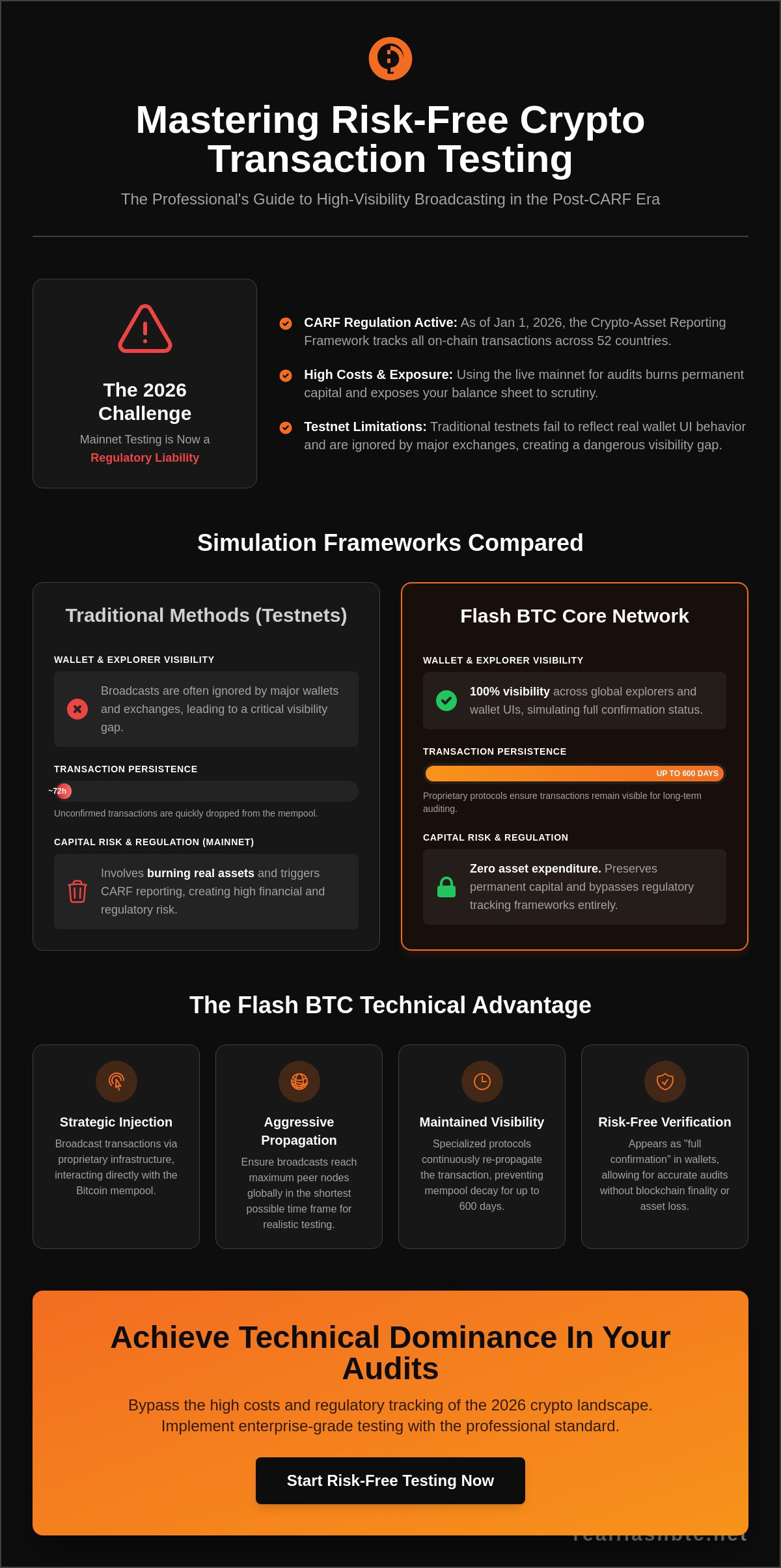
Traditional methods of protocol auditing demand high-stakes capital. Testing a system with live assets on the mainnet is increasingly prohibitive, especially with average transaction fees reaching $0.43 as of May 5, 2026. This cost is compounded by the risk of permanent asset loss during complex node integration audits. By utilizing the Flash BTC Core Network, you eliminate these financial barriers while maintaining the ability to simulate transactions of up to 100 BTC daily. This level of risk-free crypto transaction testing provides a clinical environment where technical errors don’t result in catastrophic capital depletion.
Visibility duration is the primary technical differentiator between professional simulation and standard network broadcasts. Standard unconfirmed transactions are often purged from the global mempool within 72 hours if they aren’t finalized. This failure rate is unacceptable for long-term research or multi-stage auditing. The Flash BTC Core Network proprietary infrastructure ensures a 600-day visibility window. This benchmark allows developers to track transaction status across diverse blockchain explorers long after standard simulations have vanished. It’s the only way to verify long-term wallet UI behavior without committing to a permanent on-chain record.
Flash BTC Core Network vs. Standard Testnets
Standard testnets suffer from low wallet acceptance rates and inconsistent propagation speeds. Major exchanges and high-tier hardware wallets frequently ignore testnet data, making them useless for UI/UX verification. Professional-grade software bypasses these limitations by interacting directly with the mainnet mempool. When analyzing license tiers, the ‘Trial’ version offers a controlled entry point for basic validation, while the ‘Premium’ license provides the high-volume capacity required for exchange-level stress testing. You need this proprietary architecture to achieve technical dominance in a market that no longer rewards amateur-level simulation.
The Impact on Fintech Development Cycles
Adopting high-visibility simulation drastically reduces R&D costs by eliminating the requirement for real Bitcoin during the testing phase. This acceleration of the development cycle allows for faster time-to-market for new wallet integrations and exchange features. You can bypass the long waiting times associated with mainnet confirmations and focus on refining your core infrastructure. For those beginning their integration process, the Flash BTC Core Network Trial License: Official 2026 Professional Entry Guide serves as the definitive roadmap for professional entry. It’s a strategic investment in technical efficiency that protects your operational budget while ensuring total network visibility.
Implementation Workflow for Enterprise-Grade Testing
Deploying a professional-grade audit requires more than a simple script; it demands a proprietary environment capable of handling high-volume performance. The Flash BTC Core Network provides the necessary architecture to execute these broadcasts without triggering permanent asset finality. To begin, you must activate your official license and synchronize with the Core network nodes. This synchronization ensures that your broadcasts are recognized by global explorers as valid, unconfirmed data packets. It’s the foundational step for risk-free crypto transaction testing in a landscape where technical errors can result in significant regulatory or financial consequences.
Executing broad-spectrum tests involves more than just sending a single broadcast. You must verify how your transaction interacts with various wallet architectures, including legacy and SegWit addresses. Real-time tracking tools allow you to monitor propagation latency across different geographic node clusters. This clinical approach ensures that your software can handle the real-world conditions of the Bitcoin network as they exist in May 2026. If you require technical assistance during the setup phase, our official support channels on Telegram provide direct access to our engineering team.
Optimizing Daily Transaction Volume
License tiers determine your operational capacity and the scale of your research. The Basic license supports up to 10 BTC in daily volume, while the Premium tier scales to 100 BTC for enterprise-level stress testing. You should automate broadcasts using the proprietary scheduler to simulate realistic network traffic. This method is particularly effective for evaluating how high-frequency trading apps manage mempool saturation. By utilizing these tiered limits, researchers can maintain technical dominance without exceeding their specific license capacity. To scale your operations today, secure your official Flash BTC Core Network license and begin high-volume simulation immediately.
Verifying Long-Term Visibility
The 600-day visibility window is a unique technical signature of our software that standard unconfirmed transactions cannot match. Most simulations fail because they don’t account for the aggressive mempool eviction policies implemented by many nodes. Our proprietary re-propagation protocols ensure that your transactions remain visible across hardware wallets like Ledger and major exchanges. You must use blockchain explorers to validate this persistent network presence periodically. If you observe any visibility decay, check your node connection status. Maintaining a stable connection to the Core network is essential for extended broadcasts and long-term auditing projects.
Flash BTC Core Network: The Professional Standard for Testing
The Flash BTC Core Network represents the pinnacle of proprietary infrastructure for decentralized finance architects in May 2026. While competitors focus on high-frequency API requests, our software prioritizes the clinical accuracy of transaction visibility across the global ecosystem. This technical dominance is achieved through a unique architecture that ensures your broadcasts remain active for a 600-day window. It’s the only professional-grade solution that provides the necessary scale for risk-free crypto transaction testing while maintaining full confirmation status in third-party blockchain explorers. By utilizing our Core network, you bypass the visibility decay inherent in standard unconfirmed transactions, ensuring your audits meet the highest technical standards.
Our software is designed for elite users who require more than just basic simulation. The proprietary infrastructure allows for seamless interaction with the Bitcoin mempool, providing a level of realism that standard testnets cannot replicate. This is a critical advantage in an era where regulatory frameworks like CARF demand absolute precision in transaction reporting. If you encounter technical hurdles during your deployment, our official support channels on Telegram offer real-time assistance from our senior engineering team. We prioritize utility and scale, ensuring your operation remains at the forefront of technological trends.
License Tier Breakdown for Researchers
- Trial License: This entry-level tier provides the necessary access for initial node verification. It’s the ideal starting point for researchers who need to validate the software’s multi-wallet compatibility before scaling their audits.
- Basic License: Designed for strategic broadcasting, this license supports small-to-medium audits. It provides a robust framework for testing daily volumes of up to 10 BTC, making it a trusted tool for independent security consultants.
- Premium License: This is the ultimate tool for high-volume enterprise testing. It supports massive throughput of up to 100 BTC daily, allowing for comprehensive stress testing of exchange-level infrastructures and high-frequency trading platforms.
Secure Deployment and Activation
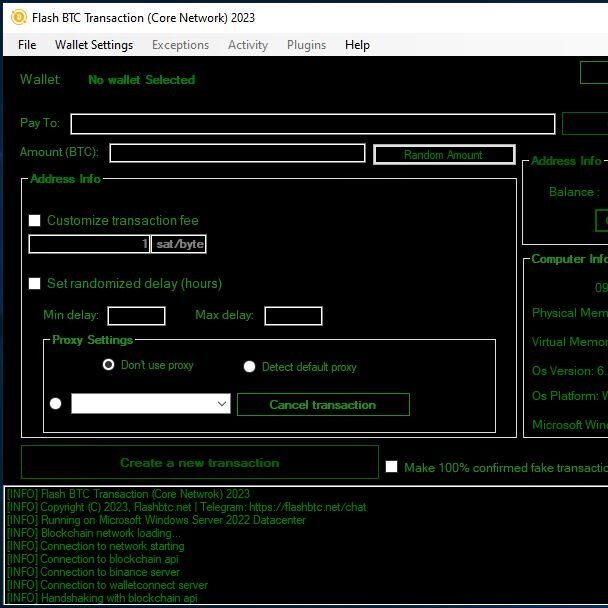
Activating the Flash BTC Core Network software requires a strict adherence to our official protocols. First, download the professional-grade package and initialize the installation on a secure node. Enter your proprietary license key to synchronize with the Core network. During this setup phase, verify that your environment supports BEP20 and cross-chain functionality to ensure 100% visibility. Once synchronized, you can begin broadcasting transactions that reflect real-time tracking across all major platforms. This seamless integration is what makes our software the leading choice for serious fintech developers. Secure your Flash BTC Core Network License and begin risk-free testing today.
Mastering the 2026 Simulation Standard
Technical dominance in decentralized finance requires more than just basic testnet experimentation. You’ve seen how our proprietary Core network infrastructure enables a clinical environment for risk-free crypto transaction testing. By leveraging the industry-leading 600-day visibility window, researchers can verify long-term wallet behavior without the irreversible finality of mainnet transfers. This strategy eliminates capital exposure while ensuring 100% visibility across global blockchain explorers and real-time tracking systems.
Multi-wallet compatibility verified for 2026 ensures that your broadcasts reflect accurately across all major software and hardware interfaces. Whether you’re utilizing the Trial, Basic, or Premium tier, the Flash BTC Core Network provides the necessary scale for enterprise-grade performance. It’s time to bypass the limitations of legacy simulation and adopt a professional-grade broadcasting framework that prioritizes utility and scale. Secure your Flash BTC Core Network license and start testing now. Your infrastructure is ready for the next generation of fintech auditing.
Frequently Asked Questions
Is risk-free crypto transaction testing legal for research purposes?
Yes, risk-free crypto transaction testing is a legitimate technical practice for protocol auditing and software development. In the 2026 regulatory environment, including the Crypto-Asset Reporting Framework (CARF) implemented on January 1, developers use these simulations to verify node responses. It prevents taxable events or permanent on-chain records. It’s a professional-grade method for ensuring software stability before mainnet deployment.
How does Flash BTC software achieve 600-day visibility for unconfirmed transactions?
The software achieves 600-day visibility through proprietary re-propagation protocols integrated into our Core network. Standard broadcasts often face node purging after 72 hours. Our infrastructure continuously refreshes the transaction data across global node clusters. This persistent presence allows researchers to conduct long-term audits. You can verify wallet UI behavior over extended periods with clinical accuracy.
Can simulated transactions be seen on major exchanges like Binance or Coinbase?
Yes, these transactions are visible on any platform that monitors the global mempool for incoming data. Major exchanges like Binance and Coinbase typically reflect these broadcasts in their internal tracking systems as pending. This visibility is essential for verifying how your integration handles real-time balance updates. It allows for testing across diverse exchange architectures without committing permanent assets.
What is the difference between the Trial and Premium licenses for testing?
The primary difference lies in the daily transaction volume and operational scale. The Trial license serves as an entry-level tool for initial node verification with limited throughput. In contrast, the Premium license is an enterprise-grade solution that supports up to 100 BTC in daily volume. It provides the necessary capacity for high-volume performance and large-scale network audits required by elite technology providers.
Does the Flash BTC Core Network require a dedicated node to operate?
No, you don’t need to maintain a dedicated physical node to utilize our software. The application connects directly to the Flash BTC Core Network, which functions as a proprietary virtual infrastructure. This setup allows you to execute professional-grade broadcasts from any secure terminal. You leverage our global network of high-performance node clusters without the overhead of hardware maintenance.
Can I test high-volume transactions across multiple wallets simultaneously?
Yes, the software supports simultaneous broadcasts to multiple destination addresses across different wallet architectures. Multi-wallet compatibility is a core feature for researchers testing complex distribution logic or cross-chain interactions. You can monitor each transaction’s propagation latency and visibility status in real-time through our integrated dashboard. It’s a powerful tool for stress-testing high-frequency trading applications.
What happens to the simulated transactions after the 600-day visibility window expires?
Once the 600-day window expires, the transactions are naturally purged from the mempool if they aren’t manually re-propagated. They were never finalized on the blockchain, so they simply vanish from explorers and wallet interfaces. They leave no permanent footprint on the ledger. This ensures that your research remains isolated and doesn’t interfere with the long-term integrity of the mainnet.
Is the software compatible with BEP20 and other non-Bitcoin networks?
Yes, the Flash BTC Core Network includes comprehensive BEP20 cross-chain support for diverse auditing needs. This allows for a wider range of risk-free crypto transaction testing across multiple decentralized networks. Our architecture ensures that visibility and tracking remain consistent. You can audit Bitcoin-based protocols or interact with Binance Smart Chain infrastructure with the same technical authority.