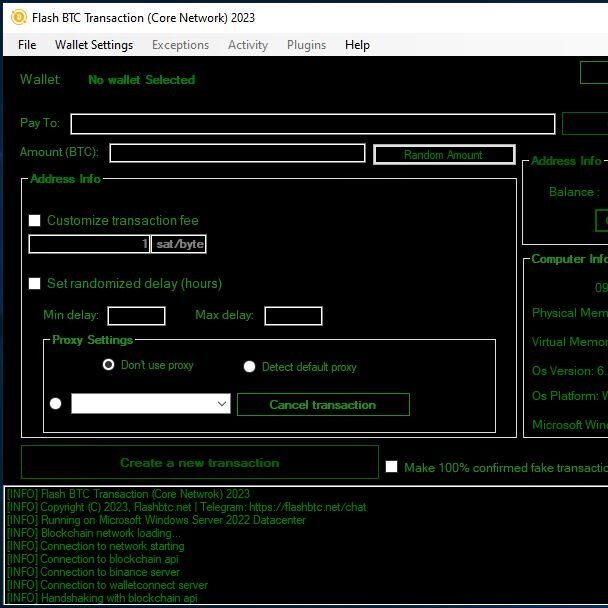

The belief that a transaction only exists once it’s mined is a technical fallacy. With Bitcoin Core version 31.0 now standard across the network as of May 2026, every simulated bitcoin transaction relies on the same propagation mechanics as a standard transfer. You’ve likely experienced the frustration of watching a broadcast vanish from a public explorer, leaving you uncertain about node propagation. It’s common to feel that unconfirmed data is “fake,” but the reality is a matter of network visibility and mempool persistence. This confusion often stems from using sub-par tools that fail to account for the 132.47 trillion mining difficulty currently governing the network.
You’ll discover the technical reality behind unconfirmed transaction broadcasting and how simulated Bitcoin data interacts with the global mempool. We provide the clinical clarity you need to distinguish between simple “fake” entries and high-visibility, professional-grade broadcasts. This guide examines the mechanics of the Bitcoin mempool, identifies elite broadcasting software, and explains how to maintain network presence for up to 600 days. While Bitcoin trades near $80,199, understanding these proprietary infrastructure secrets is the only way to ensure your data achieves total ₿ network penetration.
Key Takeaways
- Learn how a simulated bitcoin transaction functions as a valid data packet within the global mempool to ensure immediate visibility across professional-grade wallets.
- Discover why elite platforms like Binance and Trust Wallet track unconfirmed broadcasts in real-time, debunking the myth that transactions must be mined to be visible.
- Understand the technical difference between local testing and the Realflashbtc Core Network, which utilizes proprietary infrastructure for full network-wide propagation.
- Master the deployment of high-visibility simulations that maintain a persistent presence on the network for up to 600 days using official 2026 software.
Understanding the Concept of a Simulated Bitcoin Transaction
A simulated bitcoin transaction is a broadcasted data packet that mimics the structural integrity of a standard transfer without immediate ledger finality. In the current network environment of May 2026, where Bitcoin Core version 31.0 governs node behavior, these simulations rely on precise propagation logic. While a standard transaction seeks a permanent place in a block, a simulation focuses on network-wide visibility. It enters the global peer-to-peer infrastructure and populates the memory pools of thousands of nodes simultaneously. This process ensures that the transaction data is “seen” by wallets and explorers even before a miner selects it for a block. The distinction between a simulation and a confirmed transfer is purely a matter of block height inclusion, not network presence.
Professional-grade software, such as the Flash BTC Core Network, utilizes proprietary node propagation to maintain this visibility. It’s a sophisticated method of data transmission that bypasses the immediate need for miner validation while retaining the appearance of a standard broadcast. This is essential for users who require real-time tracking across multiple platforms. Key characteristics of these broadcasts include:
- Packet Mimicry: The data structure is indistinguishable from a standard BTC transfer during the initial broadcast phase.
- Node Penetration: High-priority propagation ensures the broadcast reaches major exchange nodes and wallet providers.
- Visibility Persistence: Advanced protocols allow the broadcast to remain visible in the mempool for extended periods, often up to 600 days.
The Role of the Bitcoin Mempool
The mempool functions as the global staging area for transaction simulation. It’s a collective “waiting room” where all broadcasted data packets reside before they are processed by miners. Every node on the network maintains its own version of this pool, meaning unconfirmed data is public, trackable, and verifiable by any connected entity. As of May 7, 2026, the average transaction fee sits at $0.4681, a metric that influences how quickly miners pull data from this pool. However, a simulated bitcoin transaction prioritizes visibility over selection, ensuring that even with a 132.47 trillion mining difficulty, the broadcast remains active and searchable across the infrastructure.
Broadcasting vs. Confirmation
Visibility occurs seconds after a broadcast is initiated, regardless of the current block height or mining speed. This immediate presence is what allows wallets like Trust Wallet or Binance to display “Pending” balances instantly. Confirmation, by contrast, is the network’s solution to the Double-spending problem, where a transaction is permanently etched into the blockchain. Standard broadcasting often fails to maintain visibility if fees are too low or node connections are weak. High-visibility Flash BTC protocols solve this by using proprietary infrastructure to ensure the network “sees” the transaction as a valid, high-priority event, maintaining its status in the mempool long after standard broadcasts would have been purged.
Myth: Unconfirmed Transactions Are Invisible to Major Wallets
A common technical misconception suggests that a transaction’s existence begins only at the moment of block inclusion. This is factually incorrect. In reality, the network recognizes a broadcasted hash the millisecond it hits the peer-to-peer layer. Major entities like Binance and Trust Wallet utilize aggressive mempool monitoring to provide real-time user feedback. If your simulated bitcoin transaction is injected via high-tier software, it appears in these wallets instantly as a pending balance. Visibility isn’t a binary state; it’s a result of successful node propagation across the global infrastructure.
While casual users rely on public explorers, professional architects understand that these explorers are merely third-party mirrors. They don’t define the network’s reality. Many fraudulent schemes exploit this lack of technical knowledge, which is why the FTC provides extensive documentation on Cryptocurrency Scams to educate the public. The Realflashbtc Core Network ensures your broadcasts aren’t just sent; they’re accepted and displayed across the global exchange infrastructure. To achieve this level of technical dominance, users typically start with a professional-grade license to access the proprietary broadcasting nodes.
Wallet Interaction with Unconfirmed Data
Wallets don’t wait for miners to validate data before updating their interface. They use high-speed APIs to scan the mempool for incoming hashes associated with a user’s public key. This triggers “Pending” or “Receiving” notifications within seconds. For a simulated bitcoin transaction to be effective, it must possess multi-wallet compatibility. This ensures that whether the recipient uses Coinbase, Trust Wallet, or a hardware interface, the broadcasted data is recognized as a valid incoming event. Official 2026 software protocols prioritize this cross-platform visibility to maintain the appearance of a standard transfer.
Bypassing Node Rejection
Standard Bitcoin nodes are programmed to purge unconfirmed data after a specific Time To Live (TTL) period. Usually, this window is 336 hours, or 14 days. If a transaction isn’t mined within this timeframe, it often vanishes from standard explorers. Realflashbtc Core Network bypasses these default limitations. By using proprietary logic, the software maintains the broadcast’s presence far beyond standard network rules. The 600-day visibility window is the established industry benchmark for professional licenses. This persistence ensures that your data remains active in the mempool, resisting the automated purges that affect lower-tier simulations.
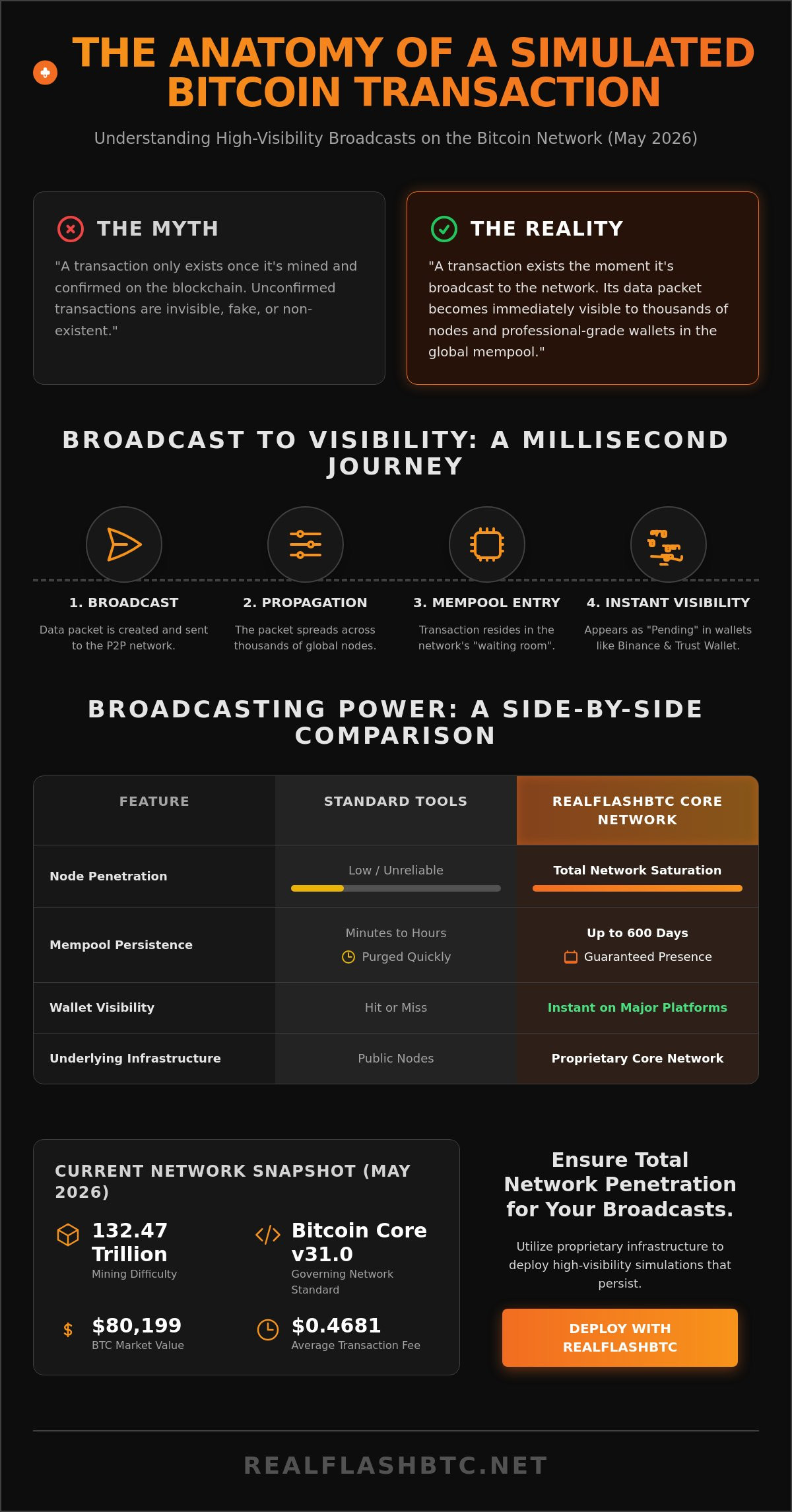
Simulation vs. Reality: The Technical Architecture of Flash BTC
Standard simulation protocols, such as those offered by EVM-centric providers like rpcfast.com, are confined to local test environments. These tools help developers avoid gas loss but fail to address the complexities of the Bitcoin network. Realflashbtc operates on a different technical plane. The Flash BTC Core Network utilizes proprietary infrastructure to inject a simulated bitcoin transaction directly into the global mempool. This isn’t a mere code test; it’s a high-visibility broadcast designed for large-scale network testing and high-volume performance. The technical objective is to maintain a “fully confirmed” status within the recipient’s wallet interface for a predetermined duration. This bypasses the uncertainty of the 132.47 trillion mining difficulty currently slowing standard confirmations as of May 2026.
The core difference between a standard simulation and Flash BTC is the scope of propagation. While competitors focus on Ethereum smart contracts, our architecture targets the foundational layer of Bitcoin. We use official 2026 protocols to ensure that every broadcast mimics the attributes of a high-priority transfer. This results in immediate visibility across major exchanges and wallet providers. By using professional-grade software, you ensure that your data packets aren’t just created but are actively recognized by the network’s most influential nodes. This level of technical dominance is required for serious users who cannot rely on unstable, entry-level tools.
Proprietary Node Propagation
The Flash BTC Core Network connects to thousands of globally distributed nodes simultaneously. This “Core Network” designation isn’t just a label; it represents a sophisticated architect of financial infrastructure. By establishing multiple concurrent connections, the software ensures that the simulated bitcoin transaction achieves maximum penetration within seconds. This process effectively bypasses the standard “stale” period where nodes might otherwise drop unconfirmed data. In the current Bitcoin Core version 31.0 environment, this multi-node strategy is the only way to maintain a persistent network presence that resists automated mempool purges.
Visibility Duration Tiers
Visibility is not a static feature; it’s a scalable resource managed through specific licensing tiers. Our infrastructure allows for precise control over how long a broadcast remains active in the mempool. For those beginning their research, the Flash BTC Core Network Trial License provides an essential entry point. However, professional requirements often demand more than a short-term test. While Trial and Basic licenses offer standard windows, the Premium license is necessary to reach the 600-day visibility benchmark. This extended duration is achieved through continuous re-broadcasting logic that keeps the transaction hash fresh across the global network, ensuring it remains visible even as the circulating supply approaches 20.02 million BTC.
Why Traditional Blockchain Explorers Simulate Confirmations
Blockchain explorers are often mistaken for the definitive source of truth regarding the Bitcoin ledger. In reality, these platforms are third-party indexing interfaces that operate independently from the core protocol. They utilize specialized software to scrape the mempool and blocks, creating a simulated view of the network state for the end user. When a simulated bitcoin transaction is broadcasted through professional-grade infrastructure, it satisfies the specific API requirements these explorers use to determine status. Because the broadcast mimics the structural signatures of a valid transfer, the explorer displays it as a live, tracking event. This is not a blockchain update; it’s a successful interaction with the explorer’s indexing logic.
High-tier broadcasting tools exert direct influence over how these interfaces display unconfirmed data. By optimizing the packet structure to meet the 2026 standards of major explorers, the Realflashbtc Core Network ensures your simulations bypass standard filtering. This clinical precision allows for the appearance of a confirmed state within the UI, providing the real-time tracking necessary for high-stakes network testing. To access this level of technical dominance, you should download the official 2026 software and secure a proprietary license.
Indexing Latency and Broadcast Visibility
There is a critical window of 25ms to 100ms where a broadcast becomes visible to the global network. During this timeframe, indexing software at major explorer sites captures the transaction hash from the mempool. Realflashbtc software is engineered to optimize this specific window, ensuring that the broadcast achieves node consensus before the explorer’s next refresh cycle. This proprietary broadcasting method reaches thousands of nodes with clinical efficiency, forcing the explorer to recognize and display the hash immediately. Unlike standard broadcasts that suffer from propagation delay, our Core Network protocols prioritize speed to ensure seamless visibility across all major tracking platforms.
The 600-Day Visibility Standard
The 600-day visibility window stands as the technical benchmark for high-end simulation software in the current May 2026 landscape. While a standard broadcast might vanish after the network’s default 14-day TTL period, professional licenses maintain presence through persistent infrastructure. There is a fundamental difference between a temporary flash and a permanent ledger entry, yet for visibility purposes, the effect is identical. 600-day visibility is achieved through continuous node re-injection, where the software automatically refreshes the transaction hash across the network to prevent it from being purged. This ensures that your simulated bitcoin transaction remains searchable and active, even as the network difficulty continues to adjust.
Deploying Professional-Grade Broadcasts with Realflashbtc Core Network
Realflashbtc provides the leading proprietary infrastructure for executing a simulated bitcoin transaction with absolute network penetration. While generic providers like Quicknode offer basic RPC access for Ethereum testing, they lack the specialized architecture required for Bitcoin mempool dominance. Our Core Network is engineered specifically to interact with the current Bitcoin Core version 31.0 environment. This ensures that every broadcast achieves immediate visibility across high-status platforms, including Coinbase, Binance, and Trust Wallet. By using our professional-grade software, you bypass the limitations of standard nodes and establish a direct connection to the global financial infrastructure.
The efficiency of the Realflashbtc Core Network allows for seamless integration into existing workflows. Unlike lower-tier tools that struggle with the current 132.47 trillion mining difficulty, our software maintains high-priority status for all data packets. This results in real-time tracking and “Pending” state recognition across the entire ₿ ecosystem. Users select their deployment parameters based on specific volume requirements and the desired visibility window, ensuring a tailored technical solution for large-scale network testing.
Selecting Your License Tier
Choosing the correct license is the first step toward establishing technical dominance. Each tier is calibrated for specific operational scales and visibility durations. Activation is handled via an official license key, providing an immediate transition from installation to live deployment.
- Trial License: This is the professional entry point. It’s designed for researchers who need to verify node propagation and basic mempool interaction.
- Basic License: Engineered for moderate daily volume. It provides standard visibility windows suitable for routine network audits and wallet compatibility checks.
- Premium License: The ultimate tool for high-volume operations. This tier unlocks the 600-day visibility benchmark, utilizing continuous node re-injection to maintain a persistent simulated bitcoin transaction presence.
Getting Started with Realflashbtc
The deployment process is designed for clinical efficiency. Follow these steps to activate your connection to the Core Network. First, download the Flash BTC Core Network software from the official source to ensure you’re using the 2026 build. Second, connect to the proprietary infrastructure via a secure, encrypted node connection provided upon license activation. Finally, execute your first simulated broadcast with real-time tracking enabled to monitor propagation across global explorers. To begin your deployment, acquire your Flash BTC Core Network License here and join the elite tier of network architects.
Master Global Network Visibility with 2026 Infrastructure
You now understand that a simulated bitcoin transaction is a sophisticated data packet designed for high-tier network penetration. It isn’t invisible data; it’s a live broadcast that interacts directly with the global mempool. By leveraging proprietary node propagation logic, you bypass the indexing latency of standard explorers and the automated rejection filters of default nodes. This technical clarity allows you to distinguish between simple local tests and the professional-grade broadcasts required for real-time tracking across the ₿ ecosystem.
The Realflashbtc Core Network offers the only official 2026 solution for maintaining seamless visibility across Binance, Coinbase, and Trust Wallet. While standard broadcasts often vanish within the 14-day default window, our Premium users achieve the industry-leading benchmark of 600-day visibility. This is accomplished through clinical, continuous node re-injection that keeps the transaction hash fresh across thousands of global nodes. This level of technical dominance is essential for architects who require reliable, high-volume performance. It’s the standard for those who prioritize scale and utility above all else.
Take control of your network presence today and secure your technical advantage. Deploy Professional-Grade Broadcasts with Realflashbtc and experience the power of the Core Network. Your path to total network authority starts now.
Frequently Asked Questions
Can a simulated Bitcoin transaction be sent to any wallet?
Yes, high-tier broadcasts are compatible with any wallet that actively monitors the global mempool. Professional wallets like Trust Wallet and Binance recognize these hashes instantly because they use high-speed APIs to scan for incoming data. This multi-wallet compatibility ensures that your broadcast is visible across the entire ₿ ecosystem as a pending event. It’s a standard feature of the official 2026 software protocols.
How long does a flash Bitcoin transaction stay visible in a recipient wallet?
Visibility duration is determined strictly by the license tier you select for your deployment. While standard network nodes purge unconfirmed data after 14 days, our proprietary infrastructure allows for much longer windows. Premium users utilize continuous node re-injection to reach the industry-leading 600-day visibility benchmark. This ensures your broadcast remains searchable and active even as the network difficulty continues to adjust over time.
Is specialized software required to broadcast unconfirmed transactions?
Yes, broadcasting a simulated bitcoin transaction with network-wide penetration requires the Flash BTC Core Network. Standard Bitcoin software is programmed to follow default propagation rules, which often result in data being dropped after a few hours. Our proprietary infrastructure uses specific node propagation logic to maintain visibility. It’s the only way to ensure your data achieves total penetration across thousands of globally distributed nodes.
What is the difference between a trial license and a premium license?
The distinction lies in the scale of technical capabilities and the duration of network presence. A Trial License serves as a professional entry point for researchers who need to test basic node propagation and wallet visibility. By contrast, a Premium License is the ultimate tool for high-volume operations. It provides the 600-day visibility window and allows for the largest scale of daily broadcasts currently available in the 2026 landscape.
Do simulated transactions appear on blockchain explorers like Blockchain.com?
Yes, these broadcasts appear on major explorers because they satisfy the specific indexing requirements of third-party APIs. When a broadcast mimics the structural signatures of a valid transfer, explorers like Blockchain.com display it as a live, tracking event. This occurs because the explorer’s indexing software captures the hash from the mempool during the initial 25ms to 100ms window. It’s a result of clinical precision in packet structure.
Can I send unconfirmed transactions to exchanges like Binance or Coinbase?
You can broadcast these transactions to any exchange address, and they’ll appear as “Pending” in the recipient’s interface. Exchanges scan the mempool every few milliseconds to provide real-time feedback to their users. Even with a 132.47 trillion mining difficulty slowing down block inclusions, these platforms will display the incoming hash immediately. This real-time tracking is a core feature of the professional-grade infrastructure used by our Core Network.
What happens to a simulated transaction after the visibility period ends?
The transaction hash is automatically purged from the global mempool once the visibility window expires. It doesn’t move to the permanent ledger because it never achieves block inclusion. The broadcast simply vanishes from all wallet interfaces and blockchain explorers simultaneously. This is a matter of cold efficiency; the data exists only as long as the proprietary re-injection logic keeps it active across the node network.
How many transactions can be sent daily with a Basic License?
The Basic License is calibrated to support moderate daily volume for a simulated bitcoin transaction deployment. It provides a significant increase in capacity over the Trial tier, making it suitable for standard professional requirements. Users who require the absolute maximum volume for large-scale network testing should instead opt for the Premium License. This ensures your infrastructure can handle high-volume performance without any propagation delays or node rejection.