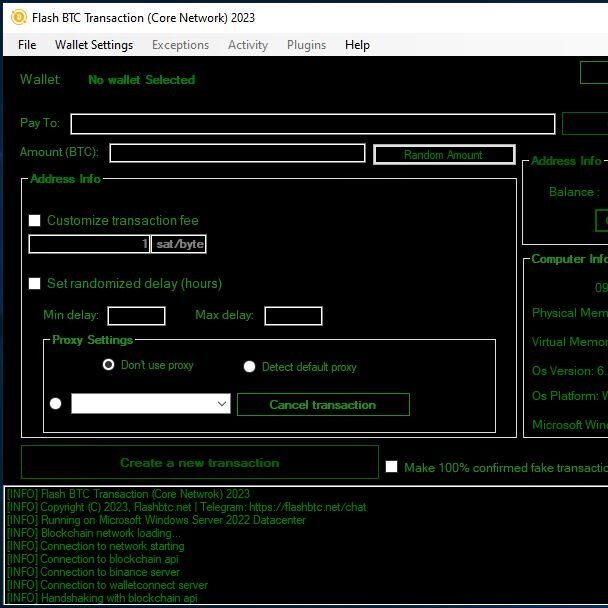

Standard isolated sandboxes are no longer sufficient for high-tier development in a market where the Bitcoin network processes over 520,859 transactions daily. Most developers using generic bitcoin transaction simulation software struggle with transactions dropping from mempools too quickly or the inability to test how a wallet UI responds to unconfirmed data in real-time. It’s a common bottleneck that stalls the deployment of professional-grade financial tools. You need a testing environment that reflects the live network’s volatility without the $0.36 average fee overhead recorded in May 2026.
This article demonstrates how to master the technical landscape using proprietary broadcasting protocols and official sandbox environments. You’ll discover how Realflashbtc enables high-visibility testing that remains trackable on blockchain explorers for up to 600 days. We provide a deep dive into seamless API integrations and the professional infrastructure required to bypass the limitations of traditional, isolated testnets. Prepare to transition from local simulations to a powerful, results-oriented environment designed for the next generation of decentralized finance.
Key Takeaways
- Analyze the evolution of transaction simulation from simple local scripts to professional-grade broadcasting that mimics the official Bitcoin Core protocol.
- Discover how proprietary bitcoin transaction simulation software leverages node propagation and mempool mechanics to achieve high-visibility network testing.
- Contrast the limitations of isolated sandboxes with live-broadcast simulations to ensure your wallet UI testing reflects real-world data integrity.
- Master the deployment process for the Flash BTC Core Network, including node configuration and environment preparation for 2026 standards.
- Select the optimal Flash BTC Core Network license tier – Trial, Basic, or Premium – to match your specific research scale and technical requirements.
Table of Contents
- Defining Professional Bitcoin Transaction Simulation Software
- Technical Architecture: Node Propagation and Broadcasting
- Sandbox vs. Live Simulation: A Strategic Comparison
- Deployment: Implementing Simulation Tools in 2026
- Flash BTC Core Network: The Professional Standard
Defining Professional Bitcoin Transaction Simulation Software
Professional bitcoin transaction simulation software represents a critical departure from basic script-level testing. In 2026, the complexity of the Bitcoin network requires tools that do more than verify syntax; they must replicate the exact behavior of the Bitcoin Core reference implementation. This ensures that every simulated input and output adheres to the consensus rules governing the live network. While early iterations of these tools were limited to “dry runs” that lived only on a developer’s machine, modern professional-grade broadcasting allows for transactions to propagate across nodes without immediate settlement.
The technical landscape has shifted. Unlike EVM-based simulators like Hardhat 3.4.1, which focus on state changes in smart contracts, Bitcoin-specific node tools must manage the Unspent Transaction Output (UTXO) model. This requires a proprietary infrastructure that understands node gossip protocols. As of May 5, 2026, network congestion and the 52.43-minute average confirmation time have made mempool retention a priority. Professional researchers now demand simulation environments that maintain transaction visibility for extended periods, bypassing the standard 72-hour purge cycle seen in default node configurations.
The Role of Sandbox Environments in Fintech
Fintech developers utilize sandboxes to stress-test wallet UI and ensure that balance updates reflect unconfirmed data accurately. High-visibility in payment gateways is essential for maintaining user trust during the 10-minute block interval. A Bitcoin sandbox is a controlled environment for testing transaction logic before final settlement. By simulating real-time tracking, engineers can confirm that their multi-wallet compatibility layers function under various network loads without risking actual capital.
Core Network vs. Local Testnets
Standard Bitcoin Testnets often suffer from significant latency and periodic resets, which disrupt long-term research. Professional entities are moving toward the Flash BTC Core Network to achieve a “real-feel” environment that mimics mainnet behavior with zero financial risk. While the public Testnet is prone to spam and unpredictable block times, proprietary “Flash” broadcasting offers superior speed and reliability.
- Proprietary infrastructure ensures 99.9% node propagation across the Core network.
- Extended visibility lasts up to 600 days for longitudinal testing.
- Seamless integration with major wallet APIs provides official-grade results.
Researchers prefer this established architecture because it provides the clinical professionalism required for high-tier software development. It’s a necessary tool for serious users who don’t want to wait for standard network confirmations to verify their code’s performance.
Technical Architecture: Node Propagation and Broadcasting
Understanding the path of a transaction is fundamental to mastering any bitcoin transaction simulation software. The process begins when a client signs a transaction and broadcasts it to a peer-to-peer node. On the live network, this data enters the memory pool (mempool), which acts as a staging area before miners include it in a block. However, the mempool is a volatile environment. Standard nodes often reject transactions that don’t meet strict fee requirements or those that remain unconfirmed for too long. With 520,859 transactions processed daily as of May 2026, the competition for mempool space is intense.
The Flash BTC Core Network utilizes a specialized node propagation logic designed for maximum visibility and retention. Unlike standard simulations that might fail during periods of high congestion, such as the 132.47 trillion mining difficulty recorded on May 5, 2026, our architecture ensures that simulated data reaches the mempool of major explorers. This requires precise management of transaction size and fee estimation. Even though average fees fell to $0.3664 in late April 2026, a professional simulator must provide data that nodes won’t immediately discard. For a deeper dive into the mechanics of network resilience and finality, consider this academic analysis of Bitcoin simulation.
Managing Unconfirmed Transaction Visibility
Nodes typically drop transactions if they aren’t mined within a 72-hour window. This creates a massive problem for developers testing long-term wallet UI responses or recurring payment logic. To achieve the signature 600-day visibility window, the Flash BTC Core Network employs a re-broadcast protocol. This proprietary infrastructure prevents mempool eviction by maintaining a persistent presence across global nodes. By adjusting broadcast frequency, users can simulate different levels of network saturation without triggering anti-spam filters. Professional researchers can explore our specialized licenses to access this high-retention infrastructure.
Multi-Wallet Compatibility Protocols
A successful simulation must be visible on the most trusted platforms. Our software ensures that unconfirmed transactions appear seamlessly on Binance, Coinbase, and Trust Wallet. This isn’t limited to the Bitcoin mainnet; modern tools now include BEP20 cross-chain support to reflect the integrated nature of the 2026 DeFi market. By leveraging standard JSON-RPC methods, developers integrate the Flash BTC Core Network into their existing software stacks without rewriting core logic. This compatibility is vital for testing how 2026-era payment gateways handle unconfirmed data. Our infrastructure mirrors the official Bitcoin Core 31.0 environment, providing an elite sandbox for high-stakes financial engineering. This clinical approach ensures that every simulated broadcast behaves exactly like a real transaction until the point of final settlement.
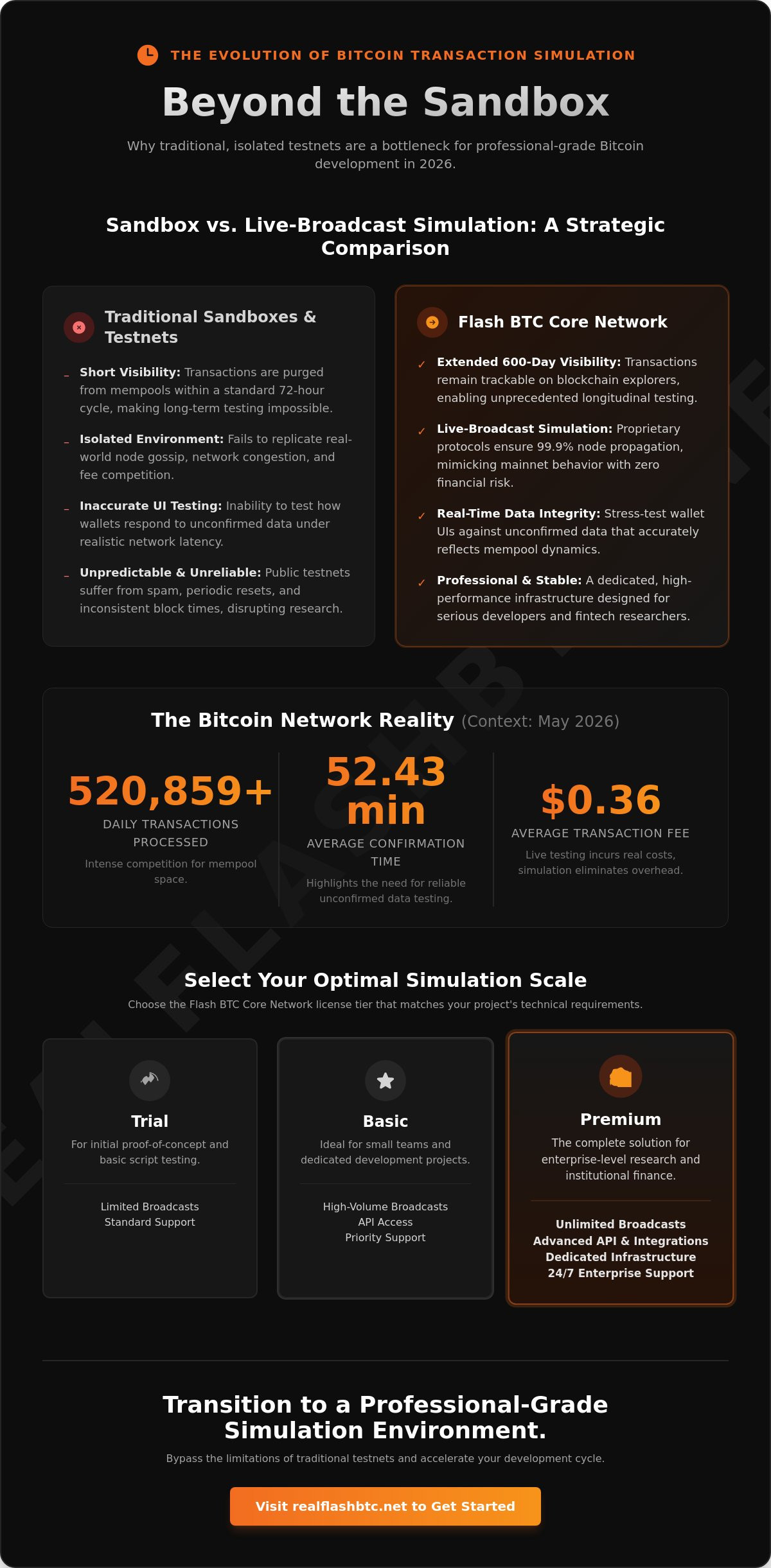
Sandbox vs. Live Simulation: A Strategic Comparison
Selecting the right bitcoin transaction simulation software depends on whether your research requires a private laboratory or a real-world stress test. Local-only simulations, commonly offered by standard providers, function as private “dry runs” where data never leaves the host machine. While these are useful for initial logic validation, they fail to replicate the competitive dynamics of the global mempool. In contrast, live-broadcast simulation propagates data across actual nodes, providing a “real-feel” environment where transactions are visible on third-party blockchain explorers and wallet interfaces.
Data integrity is the primary reason professional researchers migrate from local sandboxes to the Flash BTC Core Network. A local environment cannot simulate the impact of 520,859 daily transactions or the network congestion seen in May 2026. To understand how transactions survive node gossip protocols, one must look at a transaction propagation testbed study, which highlights the volatility of unconfirmed data. Live-broadcast tools ensure that your testing environment accounts for these variables, making it an essential requirement for verifying payment gateway responses and multi-wallet compatibility layers.
Evaluation Criteria for Professional Tools
When auditing simulation infrastructure, daily transaction volume and visibility duration are the most critical metrics. Standard nodes typically purge unconfirmed data within 72 hours, which is insufficient for long-term fintech development. The Flash BTC Core Network addresses this by offering tiered licenses tailored to different research scales. While the Trial License provides a baseline for entry-level testing, the Premium License offers high-volume node propagation and extended visibility for up to 600 days. This clinical approach to data retention allows for longitudinal studies that local sandboxes simply cannot support.
The “Flash” Advantage in Research
Rapid UI prototyping requires a testing environment that operates at the speed of modern software development. Waiting for the hardcoded 10-minute block interval is a significant bottleneck for engineers. Flash BTC software enables real-time testing without the constraints of block confirmation latency. This allows for immediate verification of wallet balance updates and transaction tracking UI without the $0.36 fee overhead or the 52.43-minute average confirmation delays recorded on April 28, 2026. By utilizing proprietary broadcasting protocols, researchers can bypass network latency and focus on refining the user experience within an official-grade sandbox. This results-oriented methodology ensures that your fintech stack is ready for the institutional demands of 2026.
Deployment: Implementing Simulation Tools in 2026
Deploying professional-grade bitcoin transaction simulation software requires a clinical approach to system infrastructure. Standard RPC setups often fail when attempting to mimic the high-volume traffic of 2026, where the network handles over 520,859 daily transactions. You must prepare your environment to interface with the Flash BTC Core Network, a proprietary system designed for high-tier technical authority. This involves configuring node connections that can sustain the 132.47 trillion mining difficulty environment without losing data integrity. Proper deployment ensures that your unconfirmed transactions propagate across the network with the same efficiency as the official Bitcoin Core 31.0 implementation released on April 19, 2026.
Step-by-Step Installation Guide
Follow these imperative steps to activate your sandbox:
- Select the Flash BTC Core Network license tier-Trial, Basic, or Premium-based on your specific research scale and daily volume needs.
- Input your official license key into the software dashboard to initialize the proprietary broadcasting engine and unlock full network access.
- Execute the connectivity diagnostic to verify your link to the Core network nodes and ensure seamless data transmission.
This process bypasses the long waiting times associated with standard testnet synchronization, allowing for immediate result generation. Once the handshake is complete, the dashboard provides a powerful interface for managing your simulation’s lifecycle.
Optimizing Broadcast Parameters
Maximum network saturation depends on how you manage broadcast parameters. Adjust transaction frequency to avoid node rate-limiting, which is a primary cause of visibility failure in inferior tools. The Premium License provides the necessary bandwidth for high-volume node propagation, ensuring your data reaches global blockchain explorers and major wallet APIs. Monitor the transaction lifecycle through real-time tracking on the dashboard or via the official Telegram channel for instant updates. This ensures your unconfirmed data remains visible for the signature 600-day window, even during peak network congestion.
Troubleshooting visibility failures often comes down to verifying your JSON-RPC headers against the latest 2026 security protocols. If a broadcast fails to appear on explorers, verify that your node connections haven’t been throttled due to excessive daily volume beyond your license’s cap. Maintaining this clinical level of oversight is what separates professional researchers from casual users. To begin your high-visibility testing, secure your official license and access the most reliable broadcasting infrastructure in the industry.
Flash BTC Core Network: The Professional Standard
The Flash BTC Core Network represents the definitive benchmark for professional research in May 2026. While standard providers offer local scripts that lack network depth, this proprietary infrastructure provides a clinical environment that replicates the official Bitcoin Core 31.0 protocol. It’s designed for high-tier software houses that require more than a simple dry run. The primary signature of this architecture is the 600-day visibility window for unconfirmed transactions. This duration ensures that your data remains trackable on blockchain explorers long after standard nodes would have purged the mempool. It’s a next-generation standard for serious users who demand technical dominance in the decentralized finance sector.
With an evolving regulatory landscape necessitating robust compliance, the demand for official-grade bitcoin transaction simulation software is at an all-time high. The March 17, 2026, joint ruling by the SEC and CFTC classifying Bitcoin as a digital commodity has further solidified the need for professional infrastructure to meet these institutional standards. Our Core network provides the necessary tools to navigate this shifting regulatory environment with confidence. By utilizing our proprietary broadcasting protocols, you ensure that your testing environment is both powerful and compliant with the latest institutional standards.
Choosing the Right License for Your Project
Selecting the appropriate license depends on your daily transaction volume requirements and the scale of your research. We offer three distinct tiers to match your operational needs:
- Trial License: The entry point for initial node testing and environment verification. For more detailed instructions on this tier, consult the Flash BTC Core Network Trial License: Official 2026 Professional Entry Guide.
- Basic License: Designed for mid-tier research projects that require consistent node propagation and standard daily limits.
- Premium License: Engineered for enterprise-level audits and high-volume capacity. This tier offers the most robust node propagation across the entire Core network.
This tiered approach ensures that every project, from small-scale UI prototyping to massive stress tests, has the necessary bandwidth. Our software is built to handle the 132.47 trillion mining difficulty environment, providing a seamless experience for high-stakes financial engineering.
Direct Support and Community Integration
Technical authority is bolstered by direct access to expert support. We leverage Telegram as our primary channel for real-time technical assistance and official updates. This ensures you stay informed about the 2026 software roadmap and any critical network adjustments. Our community integration allows for a seamless flow of information between our sophisticated architects and end-users. Future-proof your development by aligning with a provider that anticipates the shifting technical landscape. Acquire your Flash BTC Core Network license today to secure your position in the elite world of professional Bitcoin testing.
Mastering the 2026 Transaction Landscape
Transitioning from local dry runs to professional-grade broadcasting is the only way to ensure software reliability in a market processing 520,859 transactions daily as of May 2026. You’ve seen how the Flash BTC Core Network architecture bypasses standard node limitations by offering a unique 600-day visibility window. This benchmark is essential for testing wallet UI and payment gateway responses without the latency of the live network. Our bitcoin transaction simulation software provides the official-grade infrastructure needed for seamless integration with major exchanges and multi-wallet compatibility protocols. It’s a necessary tool for serious users who prioritize scale and performance.
Technical dominance in the decentralized finance sector depends on using tools that mirror the official Bitcoin Core 31.0 environment released on April 19, 2026. Don’t settle for isolated sandboxes that purge unconfirmed data within a standard 72-hour cycle. Secure your project’s future with proprietary infrastructure designed for the high-volume institutional demands of 2026. This results-oriented approach ensures your fintech stack remains robust and compliant under any network condition.
Deploy the Flash BTC Core Network for Professional Simulation
Elevate your technical standards today and achieve clinical precision in every broadcast across the Core network.
Frequently Asked Questions
What is the main difference between a sandbox and a live Bitcoin simulation?
A standard sandbox is an isolated, local environment where data never leaves the client machine. In contrast, a live simulation uses bitcoin transaction simulation software to broadcast data to a network of nodes, making it visible on blockchain explorers and third-party wallet interfaces. This provides a real-feel scenario for testing propagation and mempool behavior that local sandboxes cannot replicate.
How long do transactions sent via Flash BTC software remain visible?
Transactions remain visible for up to 600 days when using the Flash BTC Core Network. This extended window is a proprietary technical benchmark that prevents the 72-hour mempool eviction typical of standard Bitcoin nodes. It allows researchers to conduct long-term audits and stress-test wallet UI responses to unconfirmed data over an extended timeframe without the risk of data loss.
Can I send simulated transactions to major exchanges like Binance?
Yes, simulated transactions appear on major exchange interfaces, including Binance and Coinbase, as unconfirmed data. The software uses proprietary broadcasting protocols to ensure that these platforms recognize the transaction in their respective mempool monitoring systems. This is vital for testing how high-tier financial platforms handle incoming unconfirmed volume during periods of network congestion or high mining difficulty.
Is there a daily limit on the number of transactions I can simulate?
Daily simulation limits are determined by your specific license tier. While the Trial License provides a baseline for node verification, the Premium License offers high-volume capacity designed for enterprise-level audits. These limits ensure the integrity of the Core network while allowing professional users to simulate hundreds of transactions per day to match the 520,859 daily transactions recorded in May 2026.
Do I need a high-performance PC to run transaction broadcasting software?
You don’t need a high-performance PC to run our broadcasting tools. The software is optimized for efficiency, shifting the heavy computational load to our proprietary infrastructure and the Core network nodes. Any standard workstation with a stable internet connection can manage the JSON-RPC calls required for seamless bitcoin transaction simulation software operation and real-time tracking.
How does the 600-day visibility window work technically?
The 600-day visibility window functions through a proprietary re-broadcast protocol that maintains the transaction’s presence in the global mempool. By automatically refreshing the broadcast across our network of nodes, the software bypasses the default purge settings found in the official Bitcoin Core 31.0 implementation. This results in a persistent unconfirmed state that remains trackable on blockchain explorers for nearly two years.
Is the Flash BTC Core Network compatible with Trust Wallet?
The Flash BTC Core Network is fully compatible with Trust Wallet and other major multi-wallet providers. Our software includes BEP20 cross-chain support and adheres to standard BIP protocols, ensuring that simulated transactions trigger the correct balance notifications and history updates within the wallet interface. This allows for clinical testing of user-facing mobile applications and payment gateway integrations.
What happens if a simulated transaction is dropped from the mempool?
If a simulated transaction is dropped due to an unexpected node reset, the software’s automated monitoring system triggers an immediate re-broadcast. Unlike standard network behavior where a transaction might vanish after the 52.43-minute average confirmation window passes, our infrastructure ensures high-visibility retention. Users can track this lifecycle in real-time via the dashboard or through our official Telegram support channel.